What Are We Teaching the Next Generation Through Social Media?
Behabtu Woldesenbet • 10/9/2026
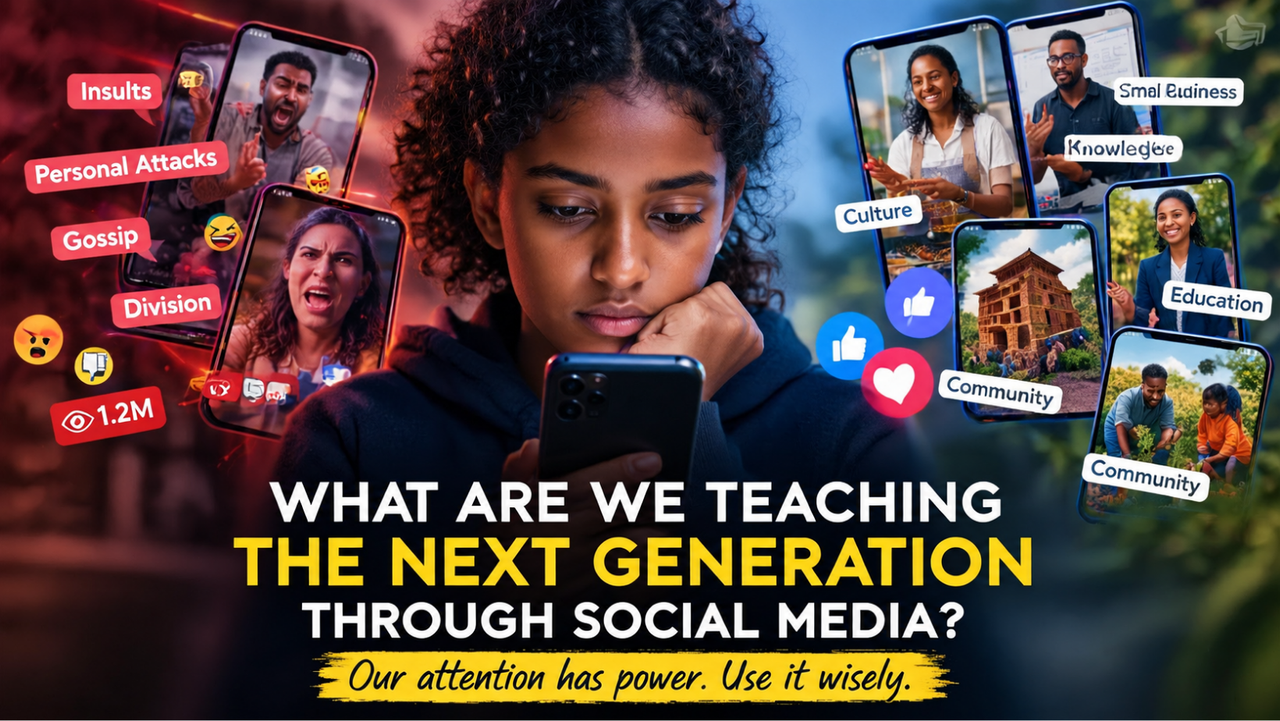
Social media has become one of the most powerful forces shaping how we communicate, learn, debate, promote businesses, and influence the next generation. But after spending more time on platforms like TikTok, Instagram, Facebook, and X, I have become increasingly concerned about what we choose to reward with our attention. Too often, insults, gossip, personal attacks, and destructive arguments receive far more engagement than education, entrepreneurship, culture, respectful debate, or community service. This article is a personal reflection on what I have observed, the role we all play as viewers and participants, and how we can use our likes, shares, comments, and attention to help build a healthier and more constructive social media culture.
What Are We Teaching the Next Generation Through Social Media?
This article reflects only my personal observations and opinions. It is not intended to describe every social media creator, channel, or user.
Over the past few months, I have been spending more time on social media than I normally do.
Facebook has always been my main platform. But recently, I have also spent more time on TikTok, Instagram, and X.
Most of the time, I use social media for business. I promote what I am working on, share information that I believe may benefit our community, support other businesses, and occasionally discuss issues that I think deserve attention.
I honestly cannot remember the last time I posted much about my personal or family life.
But spending more time on these platforms has allowed me to observe something that has been bothering me.
Especially on TikTok.
Especially within some parts of Habesha social media.
And it has made me ask a simple question:
What are we becoming online?
Social Media Is More Powerful Than We Sometimes Realize
I am not here to preach about whether social media is good or bad.
It is a tool.
Like any tool, its value depends on how we use it.
Used well, social media can be extraordinary.
Someone sitting in Addis Ababa can teach something to a person in Washington.
A small business owner can introduce a product to thousands of people without paying for television advertising.
A young person can learn history, technology, finance, culture, health, or business from people they might never meet in person.
We can teach our languages.
We can preserve our cultures.
We can introduce entrepreneurs.
We can discuss difficult social issues.
We can mentor young people.
We can organize communities.
We can celebrate someone's success.
We can help a family in need.
We can inspire someone we may never know personally.
For the first time in human history, an ordinary person with a phone can potentially speak to thousands, millions, and sometimes billions of people.
Think about the power in that.
If we use that power constructively, we can help raise a generation that is informed, curious, confident, connected to its culture, aware of the world around it, and grounded in values.
We can build people.
Unfortunately, much of what I have recently observed is the opposite.
When Insults Become Entertainment
I want to be careful here.
There are many Habesha creators doing meaningful work.
There are people teaching history.
There are people discussing business.
There are people promoting Ethiopian and Eritrean culture.
There are entrepreneurs introducing their products.
There are educators, artists, professionals, comedians, community advocates, and ordinary people using their platforms positively.
They deserve recognition.
But there is another side of our social media culture that is difficult to ignore.
Too much of what receives attention is personal conflict.
Insults.
Humiliation.
Character assassination.
Gossip.
People screaming at each other.
People publicly degrading one another.
Sometimes conversations become so personal and disrespectful that you wonder what happened to the basic boundaries we were raised with.
And strangely, these are often the videos attracting enormous audiences.
Thousands of people watch.
Hundreds comment.
People share them.
People return the next day waiting for the response.
Then someone makes another video.
Then another person responds.
The conflict becomes a series.
And the algorithm keeps feeding it.
Meanwhile, someone opens a channel to explain a business idea, teach something useful, promote a product, discuss education, or introduce a community project.
Maybe 100 people watch.
Someone spends hours producing something valuable and receives 30 likes.
Another person insults someone for five minutes and receives thousands.
That should make us think.
We Cannot Blame Only the Creators
At first, it is easy to blame the person making the content.
But I started thinking about something else.
Why do they keep making it?
Because we keep watching it.
Social media platforms understand one thing very well: attention.
If thousands of us stop to watch an insulting video, argue in the comments, share it with friends, and return to see the response, the platform learns something.
It learns:
People want more of this.
So it gives us more.
In that sense, the creator is not the only participant.
The audience participates too.
Our attention has value.
Our likes have value.
Our comments have value.
Our shares have value.
Every time we engage with something, we are casting a small vote for the type of content we want the platform to promote.
That means we should also ask ourselves:
What are we rewarding?
What Happened to Disagreeing With an Idea?
Another thing that concerns me is how we debate.
Politics is understandably emotional.
Religion is deeply personal.
History can be painful.
Our countries and communities have experienced war, political division, displacement, injustice, and conflict. People carry real wounds.
So disagreement is inevitable.
There is nothing wrong with disagreement.
Actually, a healthy society needs disagreement.
But disagreement should produce ideas.
If you disagree with someone's political argument, present a stronger argument.
If you disagree with someone's interpretation of history, present your evidence.
If you disagree on religion, explain your understanding.
Challenge the idea.
Too often, however, we skip the idea completely.
Instead, we attack the person.
Their family.
Their intelligence.
Their appearance.
Their ethnicity.
Their background.
Their private life.
Their character.
The goal is no longer:
"Let me show why your argument is wrong."
The goal becomes:
"Let me destroy you so nobody listens to you."
That is not debate.
And it does not make our society wiser.
It only makes us louder.
What Does a Young Person Learn From Watching Us?
This may be the part that concerns me most.
Imagine a 15-year-old watching this every day.
Adults insulting one another.
People becoming famous through humiliation.
Creators gaining followers because they are the loudest person in the room.
Personal attacks receiving more attention than thoughtful discussion.
Business owners struggling for visibility while conflict receives thousands of views.
What lesson are we teaching?
We cannot tell young people to respect others while showing them that disrespect brings attention.
We cannot tell them education matters while giving our attention only to entertainment and conflict.
We cannot complain that our society lacks constructive leadership while ignoring people trying to do constructive work.
Young people do not learn only from what adults tell them.
They also learn from what adults reward.
We Can Choose Something Different
I do not believe the answer is to stop using social media.
Quite the opposite.
We should use it more intentionally.
When you see someone teaching something valuable, support them.
Like the post.
Share it.
Leave an encouraging comment.
When someone starts a podcast discussing meaningful issues, give them a chance.
When someone creates educational content, help that content travel.
When young people use their platforms creatively and responsibly, recognize them.
When someone promotes culture, language, history, entrepreneurship, education, or community service, amplify them.
Positive voices also need audiences.
Support Our Businesses Too
This is particularly important for small businesses.
Starting a business is difficult.
Many of our community businesses do not have large advertising budgets.
The owner may be the accountant, marketer, salesperson, customer-service representative, delivery person, and social-media manager all at the same time.
They post their restaurant.
Their clothing business.
Their coffee.
Their professional service.
Their new product.
Sometimes we scroll right past it.
We may not need their product today.
That is okay.
But supporting a business does not always require spending money.
A like costs nothing.
A share costs nothing.
A positive comment costs nothing.
But those simple actions may help that business reach hundreds of additional people.
Maybe you cannot buy the product.
Someone who sees your share might.
That is how a community supports its entrepreneurs.
Social Media Can Also Reconnect Us
There is another opportunity that I think we sometimes overlook.
Our communities are scattered across the world.
Addis Ababa.
Nairobi.
Johannesburg.
London.
Stockholm.
Toronto.
Washington.
Atlanta.
Nashville.
Los Angeles.
And many other places.
Social media gives us something previous generations did not have.
We can remain connected almost instantly.
We can share knowledge across borders.
A successful business owner can teach someone starting a business.
A professional can mentor a student.
Someone in the diaspora can discover a small business back home.
A community organization can mobilize thousands of people around a good cause.
A young person born outside Africa can learn the language, music, history, food, and traditions of their parents.
That is an extraordinary opportunity.
We should not waste it.
Before You Like, Share, or Comment
Maybe we need to start asking ourselves one small question:
What am I helping to amplify?
Am I helping useful information travel?
Am I helping a business grow?
Am I encouraging someone who is teaching?
Am I helping spread an important community message?
Am I participating in a thoughtful debate?
Or am I simply helping another insult reach another 10,000 people?
None of us will use social media perfectly.
I certainly do not.
And this article is not written from a position of moral superiority.
It comes from observation.
I spent more time scrolling.
I watched.
I listened.
And I became concerned about what receives our attention.
Because ultimately, social media is a reflection of us.
The algorithm may decide what to recommend.
But we decide what deserves our attention.
If we reward insults, insults will grow.
If we reward gossip, gossip will grow.
If we reward division, division will grow.
But if we reward knowledge, entrepreneurship, respectful debate, creativity, culture, community service, and people trying to improve themselves and others, those things can grow too.
So perhaps the question is not only:
"Why is social media becoming like this?"
Maybe we should also ask:
"What kind of social media culture are we helping to create?"
Because every view matters.
Every like matters.
Every share matters.
And collectively, our attention can either feed what is destroying our conversations or strengthen the people who are trying to build something better.
The choice belongs to all of us.
