
Business & community
From “Enibla” to Empowerment: Why We Must Learn to Build Together
Behabtu Woldesenbet • 9/21/2026
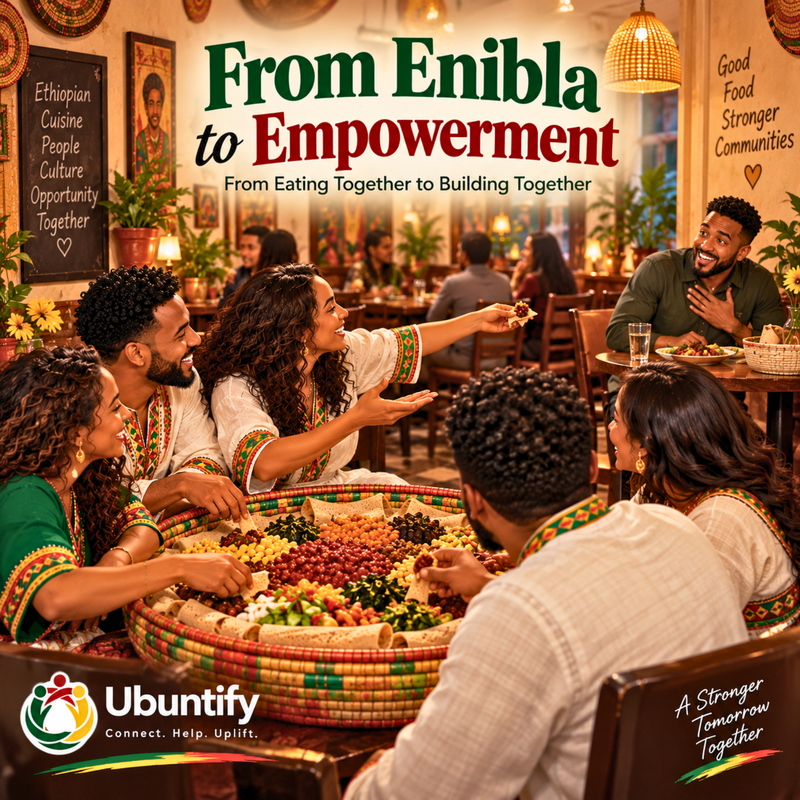
Ethiopians have a powerful tradition of sharing, supporting one another, and gathering around the same table. But how can we turn that cultural unity into economic opportunity? From supporting businesses to referrals, mentorship, and connecting generations, it is time to move from eating together to building together.
From “Enibla” to Empowerment: Why We Must Learn to Build Together
There is something about Ethiopian culture that I have always admired.
When there is a wedding, we come together.
When someone graduates, we celebrate together.
When a family loses a loved one, people show up. We contribute money. We prepare food. We sit with the family. We make sure they are not alone.
When someone is sick or going through difficulty, friends, relatives, churches, mosques, edirs, and community members often respond.
And when we gather, there is almost always food.
Sometimes many of us eat from the same plate.
“Enibla.”
Let us eat.
It is such a simple word, but it represents something much bigger about us.
Sharing a plate requires closeness. It represents hospitality, friendship, trust, and belonging.
But for years, one question has bothered me.
If we are so good at coming together socially, why have we struggled to build together economically?
Why can ten people comfortably eat from the same plate, but those same ten people may hesitate to start a business together?
Why are we generous when someone is experiencing hardship, but sometimes hesitant to support someone who is trying to build something?
Why do we celebrate someone's graduation but sometimes become uncomfortable when that same person becomes successful?
These are uncomfortable questions.
But if we want our community to become stronger, we should be willing to ask them.
We Have the People
The problem is certainly not a lack of talent.
Look at the Ethiopian community today.
We have doctors, nurses, engineers, professors, software developers, attorneys, accountants, truckers, contractors, restaurant owners, Realtors, insurance professionals, mortgage professionals, entrepreneurs, investors, and people working in almost every industry.
Some have been building businesses for decades.
Others are just beginning.
Our second generation is entering professions and industries that many first-generation immigrants could only dream about when they arrived in this country.
The talent is there.
The knowledge is there.
The money is increasingly there.
The experience is there.
What is often missing is the connection between them.
One Ethiopian may understand technology.
Another understands financing.
Another knows real estate.
Another has spent 30 years running a business.
Another understands marketing.
Another has access to professional networks.
And somewhere nearby, a young Ethiopian has a great idea but doesn't know any of them.
Think about what could happen if those people actually knew one another.
We Can Learn From Other Communities Without Copying Them
I have often looked at other immigrant communities and wondered what we can learn from them.
Chinese, Indian, Korean, and many other immigrant communities are not perfect. They have disagreements, competition, failed businesses, generational differences, and internal divisions just as we do.
But some have built strong professional and business networks that are worth studying.
People introduce one another.
Experienced professionals mentor younger professionals.
Business owners refer customers to other businesses.
Entrepreneurs exchange information.
Professional associations create relationships that eventually become partnerships, investments, jobs, and new businesses.
The important lesson is not:
“Only do business with your own people.”
I don't believe that should be our goal.
We live in a diverse society, and our businesses should compete everywhere.
The lesson is much simpler:
Know who exists in your community. Give qualified people an opportunity. And create connections that allow people to grow.
Why Are We Sometimes Harder on Our Own Businesses?
This is another question we should be willing to confront.
An Ethiopian opens a restaurant.
The food may be good, but perhaps the service is not perfect during the first few months.
We criticize it.
Someone starts a professional service.
They are still learning how to operate the business.
We wait.
Someone launches a new idea.
Before asking how we can help, sometimes our first reaction is to identify what is wrong with it.
By the time we decide the business has proven itself, it may already be struggling.
This doesn't mean we should support poor service simply because the owner is Ethiopian.
Business owners also have responsibilities.
If the community supports you, respect that support.
Improve your service.
Treat customers professionally.
Listen to criticism.
Deliver what you promise.
Charge fairly.
Build something the community can proudly recommend.
Support and accountability have to work together.
We should give our businesses room to grow.
And our businesses should give us reasons to keep coming back.
Another Person's Success Is Not Our Failure
I think this may be one of the most important changes we need to make.
Someone else's success does not take anything away from us.
A successful Ethiopian restaurant creates jobs.
A successful trucking company needs drivers, insurance, accountants, mechanics, dispatchers, attorneys, and technology.
A successful Realtor works with lenders, inspectors, contractors, insurance agents, and closing professionals.
A successful technology company may eventually hire young Ethiopian developers.
A successful entrepreneur today may become an investor tomorrow.
When we look at success only as an individual achievement, we miss its larger potential.
One person's success can create opportunities for many other people.
But that happens only when we remain connected.
Instead of asking:
"Why is that person doing so well?"
Perhaps we should start asking:
"What can we learn from them?"
And even better:
"What can we build together?"
Sometimes a Referral Is Enough
Economic empowerment does not always require millions of dollars.
Sometimes it begins with a phone number.
Someone asks:
“Do you know an accountant?”
“Do you know a contractor?”
“Do you know an attorney?”
“Do you know someone hiring?”
“Do you know a software engineer?”
“Do you know a good insurance agent?”
“Do you know someone who can help me start a business?”
Think about how many opportunities pass through conversations like these every day.
A simple referral can become someone's first customer.
It can become a job.
It can become a partnership.
It can become the relationship that changes someone's career.
But we cannot refer people we don't know exist.
That is why connection matters.
Those Who Have Succeeded Must Reach Back
We also need something from those who have already succeeded.
Mentorship.
If you have spent 20 or 30 years learning an industry, someone younger should not have to discover every lesson by making the same mistakes you made.
Teach them.
Tell them what worked.
Tell them what didn't.
Explain credit.
Explain contracts.
Explain licensing.
Explain how you found your first customer.
Introduce them to someone.
Give them an opportunity to observe you.
You don't necessarily have to give them money.
Sometimes knowledge is more valuable.
Our success becomes much more meaningful when somebody else can build on it.
And Then There Is Our Second Generation
This is where I see tremendous opportunity.
Our children are growing up differently from us.
They understand the American education system.
They speak the language naturally.
They understand technology.
They understand how professional America operates.
They are building networks that extend far beyond the Ethiopian community.
At the same time, many are trying to understand what being Ethiopian means to them.
We should not only tell them to preserve our culture.
We should invite them to help build our economic future.
Imagine connecting the experience of a first-generation Ethiopian entrepreneur with the technology skills of a second-generation Ethiopian-American.
Imagine connecting established business owners with college students.
Imagine Ethiopian professionals mentoring high-school students.
Imagine young people bringing new technology and ideas into businesses their parents spent decades building.
The first generation has something the second generation needs.
And the second generation has something the first generation needs.
The opportunity is in connecting them.
Good Intentions Are Not Enough
For years we have said:
“We need to support each other.”
“We need to work together.”
“We need unity.”
Those statements are good.
But they are not systems.
If we really want economic cooperation, we need to build the infrastructure that makes cooperation possible.
We need business networks.
Professional networks.
Mentorship programs.
Entrepreneur gatherings.
Job referrals.
Business education.
Youth entrepreneurship programs.
Investment education.
Directories where we can actually find one another.
Spaces where someone can say:
“This is what I need.”
And someone else can respond:
“I can help.”
That is how relationships become opportunity.
This Is Part of Why We Built Ubuntify
This question is deeply connected to the mission of Ubuntify.
Ubuntify was not created simply because the world needed another app.
It was created because I kept seeing the same problem:
Our people exist. Our businesses exist. Our professionals exist. Our organizations exist. Our opportunities exist. But too often, they don't know one another.
Someone is looking for a professional who is already in the community.
Someone is looking for a job that someone else knows about.
Someone has a product but needs customers.
Someone is organizing an event but needs people to discover it.
Someone has knowledge but doesn't know who needs it.
Someone wants to support an African-owned business but doesn't know where to find one.
Ubuntify is trying to shorten that distance.
Businesses.
Professionals.
Jobs.
Marketplace.
Events.
Groups.
Community.
They may look like separate features.
But they all serve one purpose:
Connecting people so something useful can happen afterward.
And this idea is bigger than the Ethiopian community.
Across Africa and throughout the diaspora, millions of people have knowledge, businesses, ideas, resources, and opportunities.
Imagine what becomes possible when we become better at finding one another.
Maybe “Enibla” Has More to Teach Us
When someone says “Enibla,” nobody is asking who owns the biggest portion of the plate.
We move closer.
We make room.
We share.
Perhaps there is an economic lesson hidden inside one of our oldest social traditions.
We already know how to sit together.
Now we need to learn how to build together.
Support the business that deserves your support.
Refer the professional who does good work.
Mentor someone younger.
Ask for help when you need it.
Share an opportunity.
Celebrate another person's success.
Introduce two people who should know each other.
And when you climb, reach back.
Because economic empowerment will not come from one successful Ethiopian.
It will come when success begins creating more success around it.
Our culture already gave us the foundation:
Community.
Hospitality.
Generosity.
Belonging.
Now we have to extend those values beyond weddings, funerals, celebrations, and the dinner table.
From eating together to building together.
From individual success to shared opportunity.
From Enibla to empowerment.
That is the community we should leave for the generation coming after us.
Connect. Help. Uplift.